

British Museum Unveils Elaborate Display for Bayeux Tapestry
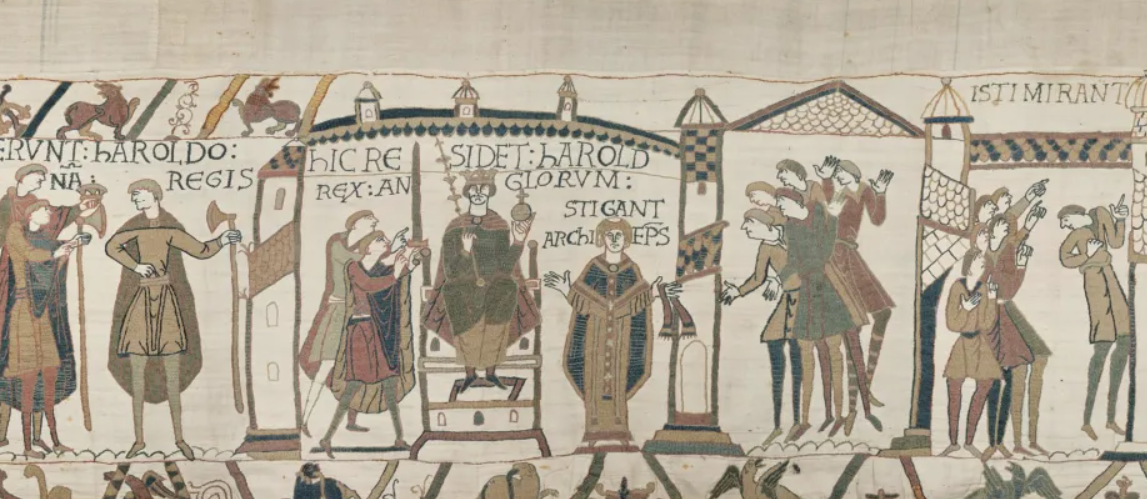
Less than four months remain until the nearly 1,000-year-old Bayeux Tapestry goes on view in its homeland for the first time in nearly a millennium—a historic loan that has nonetheless stirred up controversy. Now, London’s British Museum has unveiled just how it plans to display the UNESCO-designated relic within its walls.
The Bayeux Tapestry, which depicts the 1066 Norman Conquest of England, was uncovered during a 1476 inventory of Bayeux Cathedral, in France. While no one knows for sure where it had been before, the 230-foot-long epic was likely embroidered by a group of Canterbury-based nuns. From 1700 until 1842, authorities stored the Bayeux Tapestry rolled up—and only rolled it out for academics or dignitaries. Since 1983, the official Bayeux Tapestry Museum in Normandy has displayed the artifact vertically, in a vitrine.
The British Museum, however, will lay the work out flat for the first time in recent history. The long, unbroken display in a bespoke case will invite visitors to take in the full scope of its 58 scenes, while allowing for expanded opportunities for “digital elements” explaining this relic’s tale, according to the museum.
“The embroidery demonstrates such a mastery of craft,” Igor Tulchinsky, the WorldQuant CEO who pledged £5 million ($6.7 million) in support of the ten-month exhibition, said in a statement. “The symmetries and proportions show careful calculation. Its chronological structure reveals something equally sophisticated: a modern sense of causality and sequence. It is a narrative about decisions made under uncertainty, about commitments made before their consequences can be known.”
The Bayeux Tapestry exhibition will be accompanied by a host of other loans. The University of Oxford’s Bodleian Libraries, for instance, will contribute the renowned illustrated manuscript known as Junius II, which “was likely borrowed by the Tapestry’s creators for their depictions of clothing, ships and items of everyday life,” the British Museum said.
Other loans will elaborate on one of the show’s overarching themes—the Norman Conquest’s immediate impact. The South West Heritage Trust and Somerset Council museum will loan out silver coins from the record-breaking Chew Valley Hoard, which was likely buried amid the uncertainty stirred up by the Norman Conquest. The charter that William the Conqueror drew up after the conquest promising he’d uphold King Edward‘s existing laws will contrast those coins, courtesy of the London Archive.
These objects, said the show’s curator Michael Lewis, will illuminate how the embroidery’s “retelling of events, though ambiguous, likely deliberately so, offers a unique perspective on the past. The Norman Conquest not only impacted kings, dukes, and the elite, but also everyday people, including those who made this artwork.”
Elsewhere in the museum, visitors can enjoy an outdoor installation filled with birch trees and woodland grasses, inspired by the 11th-century landscape depicted on the tapestry.
Guests will get 40 minutes with the show once it opens on September 10. Tickets, which cost between £25–£33 ($33–$44), go on sale in July.
